
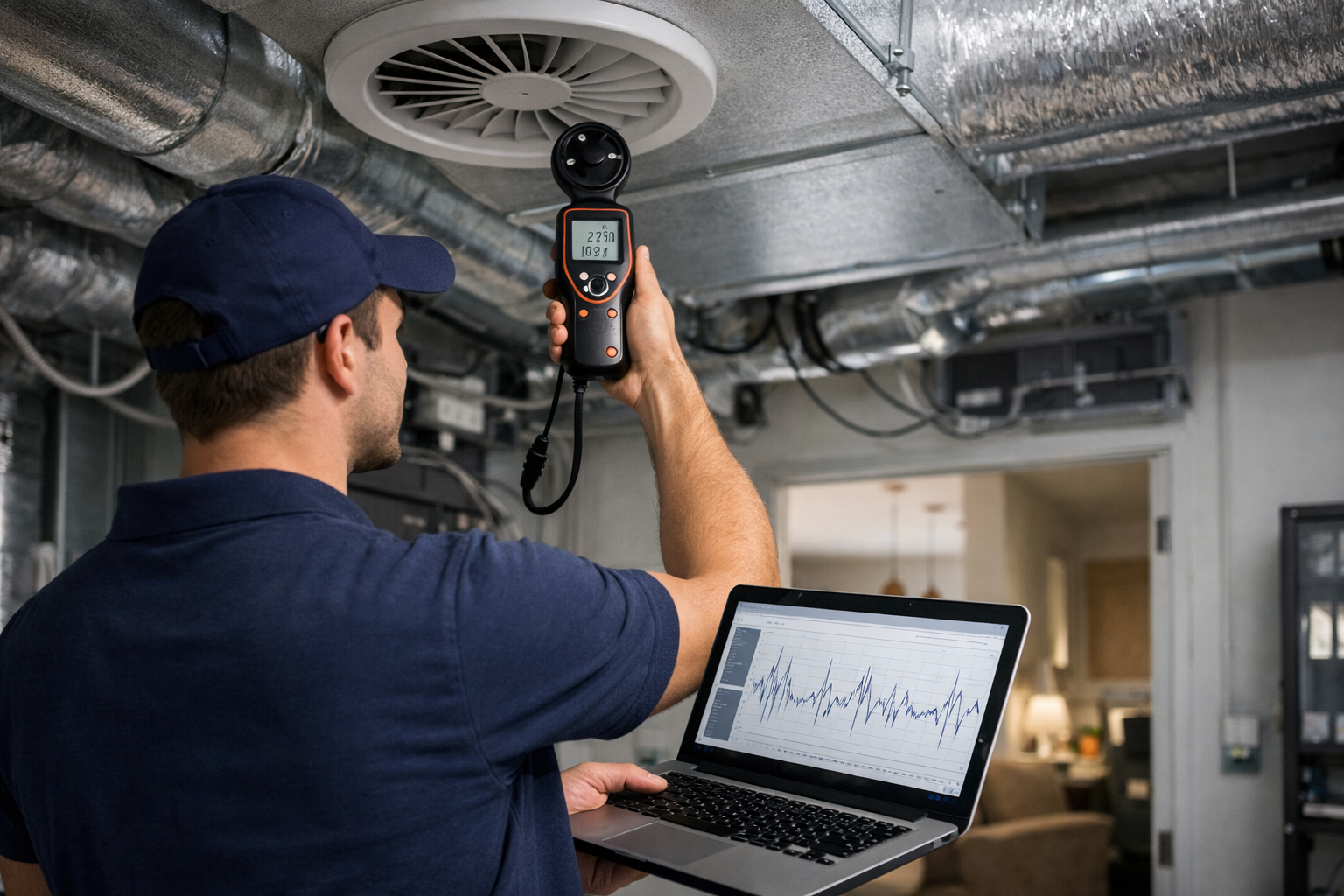
Mixed-use developments often fail comfort tests for a simple reason: the air is being asked to do too many different jobs at once. Retail wants strong ventilation and door-driven makeup air. Residential wants quiet delivery, stable humidity, and minimal drafts. Offices want predictable schedules and zone control that match occupancy. When these needs share shafts, plenums, or central equipment rooms, pressure relationships become a daily tug-of-war. Airflow imbalance shows up as hot and cold complaints, elevator odors, whistling doors, and humidity that will not settle. Diagnosing it requires treating the building like an interacting system rather than a set of separate tenants.
One building, competing airflow priorities
- Start with pressure maps, not thermostats.
A thermostat can tell you someone is uncomfortable, but it cannot tell you why the air is moving the wrong way. The first diagnostic step is building pressure mapping across key boundaries: lobby to corridor, corridor to residential units, garage to core, retail to back-of-house, and stairwells to adjacent spaces. Use basic tools such as a manometer and smoke pencils to confirm the direction and magnitude of airflow through doors, shafts, and leakage paths. Imbalances often originate in vertical connections where the stack effect and wind interact with exhaust and makeup air. A corridor that is too negative can pull odors from trash rooms, garages, and retail kitchens. A corridor that is too positive can drive conditioned air out through cracks, increasing load and causing drafts at unit doors. If pressure mapping reveals inconsistent direction changes across floors, the issue is likely not a single diffuser adjustment but a system interaction such as competing exhaust, unbalanced outside air, or uncontrolled relief paths. Goodyear, AZ air conditioner repair services often find that what looks like a single-tenant problem is actually a building-wide pressure issue caused by how air is exhausted and replaced. Once the pressure story is clear, you can target the few root drivers instead of chasing symptoms room by room.
- Trace airflow paths through shafts and shared plenums
Mixed-use buildings hide their worst airflow problems within shared pathways. Elevator shafts, stair towers, plumbing chases, and return plenums can become unintended ducts that move air between occupancy types. When a retail tenant adds a hood or increases exhaust, the building may start pulling makeup air through the easiest path, which can be a residential corridor or a leaky mechanical room. Likewise, a garage exhaust system that runs longer than designed can depressurize lower floors, pulling humid outdoor air through entrances and cracks and raising latent load for everyone above. To diagnose this, look for consistent patterns: odors strongest near cores, drafts at stair doors, temperature swings near shaft walls, or whistling at door undercuts. Then verify with targeted testing. Check door undercut flow, measure exhaust and supply volumes at shafts, and confirm whether transfer air pathways match the design intent. If the design relied on corridor return, confirm that the return path is open and not blocked by renovations or fire-safety modifications. Many imbalance problems are not new failures but rather gradual drift caused by tenant changes, damper degradation, and filter loading, which shift fan curves over time.
- Confirm fan operation, controls logic, and setpoints.
Airflow imbalance is frequently a control issue disguised as a mechanical issue. Fans may be running in modes that do not match current occupancy patterns, or outside air dampers may be stuck at positions that force the building to steal air from adjacent zones. Start by verifying fan status, speeds, and pressure setpoints for supply, return, exhaust, and makeup air units. Compare actual static pressure to the intended control range and look for signs of instability, such as rapid fan speed hunting. In mixed-use settings, competing control loops are common. A residential corridor pressurization fan might try to maintain positive pressure. At the same time, a retail exhaust system pulls harder during peak hours, causing the corridor fan to ramp up and push air into units. That leads to drafts, noise, and sometimes moisture issues around door frames. Also, verify relief paths. If relief dampers are sealed, stuck, or undersized, the building cannot shed excess air, and pressure will seek escape through doors and leakage points. Calibrate sensors used for pressure control, because drift can force fans to operate at extremes without anyone noticing. A stable pressure plan relies on accurate sensing and coordinated setpoints across systems that share air pathways.
- Room-by-room airflow verification without chasing noise
Once building-level drivers are addressed, move to targeted AIAIR distribution checks to confirm that livery matches the intended content. Measure supply and return volumes in representative spaces: residential corner units, interior units near cores, retail storefront zones, and office suites with high occupancy peaks. Look for imbalances between supply and return that could create localized positive or negative pressure. In apartments, excessive supply with weak return pathways can pressurize units and drive air into corridors, while the reverse can pull corridor air into units and carry odors into them. In retail, insufficient supply relative to exhaust can pull unconditioned air through entrances, creating hot spots near doors and increasing humidity. Avoid guessing based on noise alone, because noisy diffusers can be a symptom of high static pressure and poor throw, not necessarily high volume where it is needed. Use duct traverse where possible, confirm damper positions, and check for crushed flex, disconnected runs, or filters upgraded to higher resistance without fan adjustments. In mixed-use buildings, a small distribution issue can be amplified by central pressure problems, so always interpret room readings in the context of the larger pressure map.
Sustaining balance through seasonal and tenant change
Airflow balance in mixed-use developments is not a one-time commissioning task because the building’s driving forces change with weather, wind, and tenant behavior. Stack effect intensifies in the heating season and can reverse pressure relationships that seemed stable in summer. Retail exhaust loads may spike during the holidays, and office occupancy patterns can shift with hybrid schedules. A sustainable diagnostic approach includes seasonal checkups of pressure setpoints, fan trends, and key airflow measurements at boundaries that matter most. Establish a baseline and track deviations to detect drift early. When tenants renovate, they require a review of exhaust additions, partition changes, and door modifications that alter transfer air. Maintenance also matters: dirty coils and filters reduce airflow, stuck dampers change the outside-air fraction, and failing actuators can leave systems in fixed positions that no longer match the intended balance. The goal is a building where air moves intentionally: garages and trash rooms remain isolated, corridors stay neutral to slightly positive as designed, retail exhaust is matched with makeup air, and residential spaces stay quiet and stable. When diagnostics start with pressure relationships and follow the actual paths air takes, the fixes become smaller, clearer, and far more durable.
Also Read: Goodmooddotcom com Explained: Travel, Lifestyle, and Positive Living in One Platform