
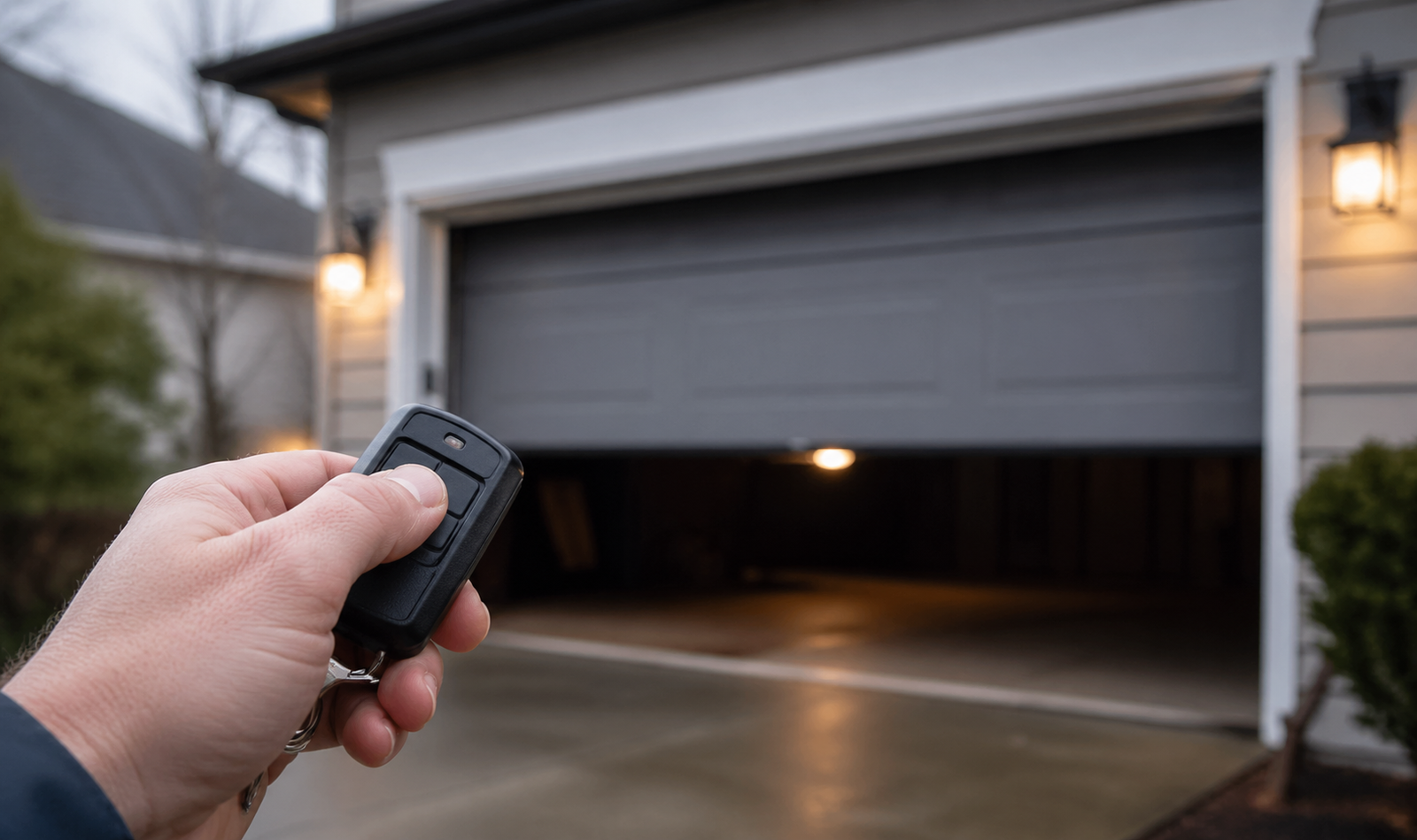
An intermittent garage door remote is easy to brush off right up until it becomes a daily operational problem. One day, it works from the driveway; the next day, it responds only from a few feet away; and then it fails altogether when access matters most.
For property managers, facility managers, and building owners, that inconsistency is more than a minor annoyance. It causes entry delays, raises user complaints, and may indicate issues with power, signal strength, interference, or the opener system itself. Garage door services do not treat intermittent remote performance issues as random glitches. They look at how the signal is transmitted, what conditions affect it, and whether the problem starts at the remote, the receiver, or the surrounding environment.
The Remote Is Only One Piece
- Inconsistent Response Usually Has A Pattern
A remote that works only sometimes is rarely failing without a reason. The first thing technicians consider is whether the issue occurs at specific distances, times of day, or under specific conditions. If the remote works well up close but not from the street, signal range becomes part of the diagnosis. If it fails only occasionally and then starts working again without any repair, that points toward unstable communication rather than complete component failure.
This pattern-based approach matters because many intermittent remote problems look identical to the user. Pressing the button with no response does not explain whether the problem is a weak battery, radio interference, a failing receiver, or a misbehaving opener logic board. Garage door services begin by narrowing the pattern, because reliable diagnosis depends on behavior, not assumption.
- Signal Problems Start Somewhere Specific
On service calls in places like Hilliard, OH, technicians often find that the remote itself gets blamed first, even when the actual problem lies elsewhere in the system. A handheld transmitter may still be functioning properly while the opener receiver struggles to consistently detect the signal, or when nearby devices interrupt the frequency path. That is why intermittent operation should be treated as a communication issue until proven otherwise.
A smart diagnosis looks at both ends of that communication. The remote has to send a clean signal, and the opener has to receive it without interference or delay. If either side is weakened, the result feels unpredictable to the user, even though the system is following a mechanical or electrical pattern that can usually be traced.
- Weak Batteries Cause Unstable Performance
One of the simplest causes of intermittent remote operation is also one of the most common. A weakening battery does not always cause immediate total failure. Instead, it often gradually reduces transmission strength, so the remote may still work at close range or only after repeated button presses. That partial function can mislead users into thinking the problem lies elsewhere, since the remote is not completely dead.
Garage door services check battery condition early because it affects range, consistency, and signal reliability. They also inspect for poor battery contact, corrosion inside the compartment, or button wear that limits proper activation. These issues may seem minor, but intermittent signal strength often begins with small drops in power that are enough to confuse operation without shutting it down completely.
- Interference Can Disrupt The Signal
Radio interference is another frequent cause of inconsistent garage door remote performance. The opener and remote rely on frequent communication, and that path can be disrupted by nearby LED lighting, wireless devices, security systems, battery chargers, or other electronic equipment. In some properties, the remote works reliably until a specific device is turned on nearby. In others, the problem appears after a new fixture or accessory has been installed in the garage area.
This is why technicians ask what changed before the problem started. If intermittent failure began after lighting upgrades, added surveillance equipment, or electrical modifications, interference becomes a stronger possibility. The key point is that signal disruption does not always come from the garage door system itself. Sometimes the opener is functioning correctly but operating in a noisier environment than it was designed to handle.
Reliable Diagnosis Starts With The Pattern
A garage door remote that works intermittently is usually signaling a weakness in power, communication, reception, or opener performance. For property managers and building owners, that inconsistency should be treated as a systemic issue worth properly diagnosing, not just a convenience problem to tolerate until full failure arrives.
Garage door services identify the cause by checking battery strength, signal range, receiver behavior, interference sources, and the opener’s response as part of a connected system. That method matters because intermittent problems rarely stay intermittent forever. When the pattern is identified early, repairs are more targeted, access becomes more reliable, and the property avoids the frustration of a recurring problem without a clear explanation.