
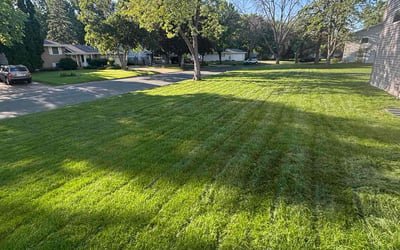
None of it worked because none of it touched the actual problem.
This is the story of that yard, told from the dirt up. It also happens to be a lesson in how Fort Worth lawns fail, which is almost never the way their owners think they do.
Most homes across Tarrant County sit on a thick mat of Houston Black clay, a swelling, alkaline soil that ranks among the densest in the state. Grass species common to the region (Bermuda, Zoysia, St. Augustine) all root differently in that medium, and each requires a different fertilizer ratio, watering interval, and pre-emergent calendar to withstand crabgrass, dallisgrass, and chinch bugs.
A grounded approach to Fort Worth lawn care treats the soil profile as the patient and the turfgrass as the symptom, which is the opposite of how most homeowners and big-box product labels frame the work. Read the dirt before reading the blade, and the rest of the season tends to write itself.
Compaction
Dell’s first instinct was logical and incorrect. He bought a granular weed-and-feed at the start of April, watered it in, and waited for green. Two weeks later, the Bermuda along his driveway looked thinner than before, and the dollar-weed near the downspout had doubled in size.
A penetrometer reading explained why. The top three inches of his lawn were packed to roughly 380 PSI, a density most turf roots cannot push through. Fertilizer was sitting on a sealed roof, feeding nothing below it.
Chemistry
The lab result came back a week later. pH 8.1. Calcium running high, iron and manganese locked out, phosphorus theoretically present yet functionally invisible to the grass.
Alkaline clay behaves this way. It hoards nutrients in forms roots cannot absorb, then punishes you for piling on more by pushing the pH even higher. Dell’s previous fertilizer applications had been making the chemistry worse for years.
The remedy was elemental sulfur, applied in small doses over two seasons, paired with a chelated micronutrient blend timed to coincide with the first warm spring rain. Boring work. No before-and-after billboard photos.
Biology
Healthy soil contains roughly a billion microbes per teaspoon. Dell’s contained a fraction of that, but it was suppressed by a long history of synthetic nitrogen flushes and zero organic matter returning to the surface.
We started leaving the clippings.
That single change, mulch-mowing instead of bagging, returned about thirty pounds of slow-release nitrogen to the lawn across a season at no cost. We added a thin top-dressing of screened compost in March and again in October. By the second year, earthworm middens dotted the back yard for the first time in a decade.
Across twelve months, the soil itself changed in ways the grass could not hide:
- Compaction at the four-inch mark dropped from 380 PSI to roughly 220 PSI.
- pH crept down from 8.1 to 7.4, well inside the range Bermuda actually likes.
- Organic matter rose from under one percent to a measured 2.6 percent.
- Root depth in a core sample doubled, from three inches to just over six.
- Weekly irrigation dropped from 1.5 inches to under an inch with no loss of color.
Patience
Year one was visually anticlimactic. The lawn stopped declining, although it did not impress anyone at the block party. Dell almost quit in August.
Then the second spring arrived.
Bermuda runners pushed across thin spots without overseeding. Dollar-weed retreated on its own, crowded out by a denser canopy that stole its light. The weed-and-feed Dell had relied on for years stayed in the garage all season, because the conditions weeds prefer no longer existed in his yard.
Translation
Most North Texas yards are running the same experiment Dell ran for a decade. The symptoms vary by neighborhood. Brown rings in mid-July, chinch bug damage near south-facing walls, take-all root rot in St. Augustine after a wet spring, and mysterious yellowing that nothing in the fertilizer aisle fixes.
The root cause is rarely the symptom; it almost always lives somewhere between the surface and the eight-inch mark.
A short field guide for Fort Worth homeowners reading their own yards this season:
- Pull a soil core before buying any product. A simple probe and a paper bag will do.
- Send a sample for soil testing every couple of years. The cost is modest compared to what most homeowners spend on guessing.
- Mulch-mow during the growing season. Bag only when scalping or managing a disease outbreak.
- Address compaction in the fall with a hollow-tine aerator. Spike aerators compress more than they relieve.
- Adjust pH with elemental sulfur, never with gypsum. Gypsum is suited to sodic soils, which are rare in this region.
Aftermath
Dell’s yard is in its third season under this approach. He spends less money than he did before, mows less often, and waters about thirty percent less. The lawn looks like the cover of a seed catalog, although that was never the point.
The point was a system that no longer needed rescue every July.
Closure
A lawn is a slow conversation with the dirt underneath it. Most homeowners try to shout at the grass and wonder why it doesn’t answer back. Sixteen months below the surface, in a single yard near the Trinity, the soil finally got a turn to speak. The blades above it simply repeated what they heard.
Also Read: Food & Beverage Packaging for High-Volume Production and Brand Consistency