
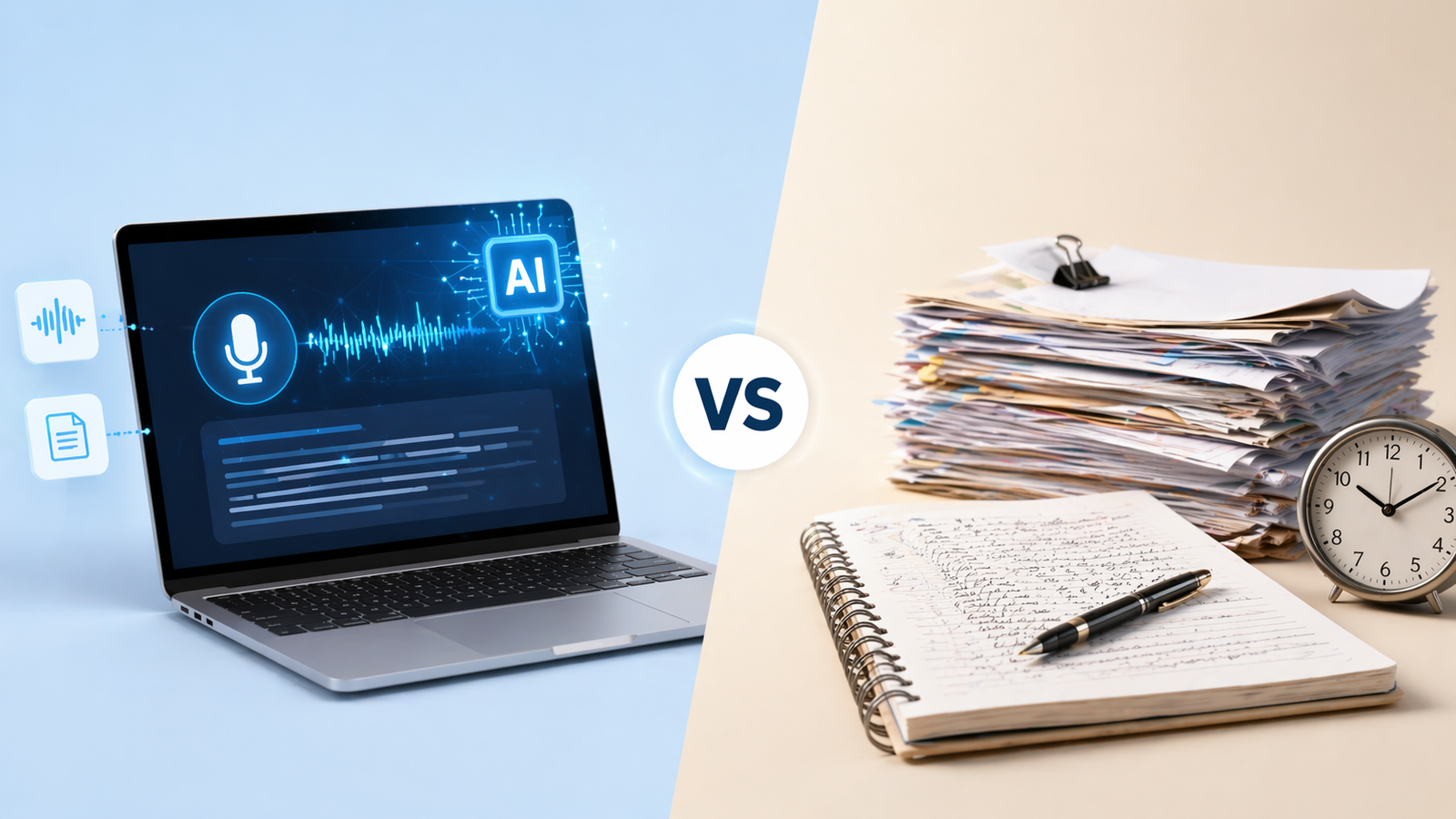
Transcribing conversations is a common task in many professional settings, from business meetings to interviews and research. Traditionally, transcription has been done manually, requiring users to listen carefully and write down what was said. While this method can be accurate, it is often slow and labor-intensive.
With the rise of AI recorders, transcription is becoming faster and more automated. These tools can convert speech into text in real time and even generate summaries. This raises an important question: which approach is more efficient in today’s work environment?
How Manual Transcription Works in Real Scenarios
Manual transcription involves listening to recorded audio and typing out the content word by word. This process requires focus, patience, and a good understanding of language, similar to working without the support of a smart translator. In many cases, users need to pause, rewind, and replay sections to ensure accuracy.
In structured environments, such as research interviews or legal documentation, manual transcription is still widely used. It allows for careful review and precise wording. However, the process can be repetitive and mentally demanding, especially for long recordings.
The Time and Effort Required for Manual Transcription
One of the biggest drawbacks of manual transcription is the time it takes. Transcribing a one-hour recording can take several hours, depending on the complexity of the conversation and the clarity of the audio.
In addition to time, the effort required is significant. Users must maintain concentration for extended periods, which can lead to fatigue and errors. For teams handling large volumes of content, this approach can slow down workflows and reduce overall productivity.
How AI Recorders Automate Transcription and Summarization
AI recorders are designed to eliminate much of this manual effort. They use speech recognition technology to convert audio into text automatically, often in real time. This allows users to access transcripts almost immediately after a conversation.
Beyond transcription, many AI recorders also offer summarization features. They can identify key points, highlight important sections, and even extract action items. This means users do not just get a transcript, but a more structured and useful version of the conversation.
Comparing Accuracy, Speed, and Overall Efficiency
When comparing manual transcription and AI recorders, speed is where AI clearly stands out. What takes hours manually can be completed in minutes with AI tools. This makes a significant difference in fast-paced environments where time is critical.
Accuracy can vary depending on the situation. Manual transcription may still have an advantage in highly technical or complex contexts where human understanding is needed. However, modern AI systems have improved significantly and can achieve high accuracy in most everyday scenarios.
In terms of overall efficiency, AI recorders offer a more balanced solution. They reduce time, lower effort, and provide additional features such as summaries and searchability. Even when manual review is needed, it is much faster to edit a transcript than to create one from scratch.
Which Option Is Better for Different Use Cases
The choice between AI recorders and manual transcription depends on the specific use case. For tasks that require absolute precision, such as legal or highly technical documentation, manual transcription may still be preferred.
For most business, academic, and everyday scenarios, AI recorders provide clear advantages. They allow users to capture and process information quickly, making it easier to focus on analysis and decision-making.
As work becomes more information-driven, the value of tools that can process and organize content continues to grow. AI recorders reflect this shift by turning recordings into usable knowledge, making them an essential part of modern transcription workflows.
Also Read: Vera Davich: The Hidden Story Behind a Private Life