
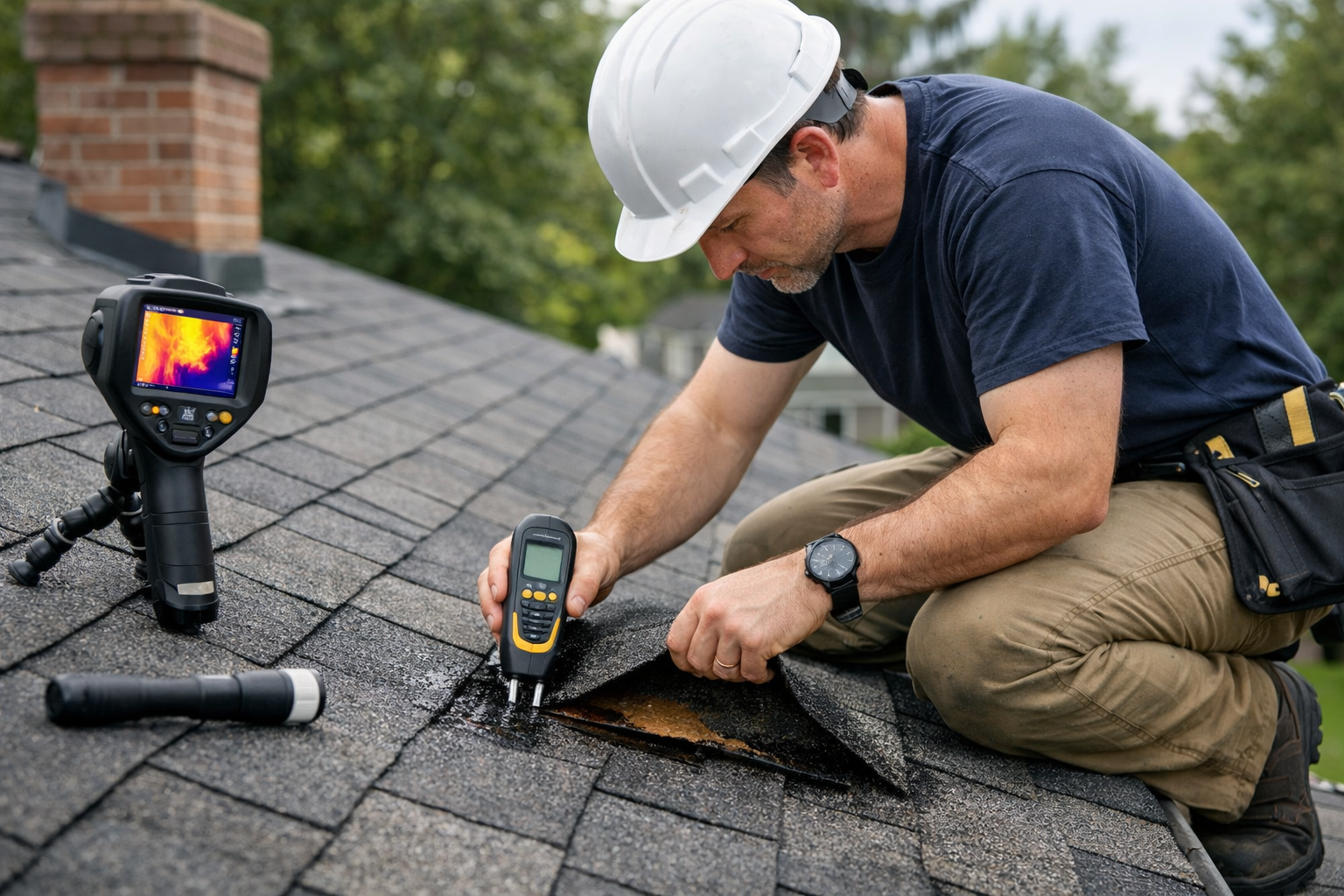
Moisture trapped beneath roofing materials is rarely obvious from the ground. A roof can look intact from the surface while water quietly affects insulation, decking, fasteners, and the layers below. By the time visible staining or interior damage appears, the hidden moisture problem has often been active much longer than anyone realized.
That is why a detailed roof evaluation matters. Property managers, facility managers, and building owners need more than a surface-level opinion when planning a reroof or replacement. A roofing contractor checks for concealed moisture to understand whether the existing system is still performing as expected, how far hidden deterioration may have progressed, and whether moisture has already compromised the roof assembly in ways that affect future replacement decisions.
Why Hidden Moisture Matters Early
- Surface Conditions Reveal Early Clues
A contractor usually starts by assessing the roof’s visible condition, but the goal is not just to identify wear on the outer layer. Subtle warning signs such as blistering, wrinkling, membrane movement, granule loss patterns, soft spots, uneven surfaces, and staining around penetrations can all suggest that moisture may be trapped below. These signs do not confirm the full extent of the problem on their own, but they help narrow where closer evaluation should begin. A roof that looks only slightly weathered can still be holding hidden moisture that affects its remaining service life.
- Why Contractors Look Beyond Appearance
A thorough evaluation goes beyond what is immediately visible because trapped moisture rarely stays confined to one simple area. Teams that publish guidance, such as more information at Bealing Roofing & Exteriors, often emphasize that roofing decisions should be based on system performance, not just the outward appearance. That distinction matters for owners considering reroofing or replacement. A section of roofing may appear stable from above, while moisture below is already affecting attachment points, insulation performance, or the substrate condition. Contractors are trained to investigate how the roof functions beneath the finished surface, not just how it appears from the top.
- Infrared Scanning Helps Locate Variations
One of the most common ways contractors check for trapped moisture is through infrared scanning. This method identifies temperature differences across the roof surface that may indicate wet areas below. Moisture tends to hold and release heat differently than dry insulation, which can create detectable thermal patterns under the right conditions. A contractor does not rely on infrared images alone as final proof, but they are extremely useful for identifying suspect zones. For property owners, this means the roof can be assessed more strategically rather than treating every section as equally affected.
- Moisture Meters Add Direct Confirmation
After suspect areas are identified, contractors may use moisture meters to gather more direct evidence. These tools help measure whether roofing components or substrate materials contain elevated moisture levels. Depending on the roof type, the contractor may assess decking, insulation zones, or other accessible areas to determine whether the reading aligns with what was observed during visual inspection or thermal scanning. This step matters because hidden moisture requires confirmation before replacement planning can be finalized. A contractor is not simply hunting for visible damage. The goal is to understand how much of the roof system has been affected and how that should influence the next phase.
- Core Samples Clarify Roof Assembly Condition
In some evaluations, contractors may recommend limited core sampling to understand better what is happening below the surface. This involves examining a small section of the roof assembly to verify the condition of the layers underneath. Core samples can show whether insulation is wet, whether materials have deteriorated, and how deep the moisture issue extends. For owners preparing for reroofing or full replacement, this information can be highly valuable. It helps determine whether the existing system can support the next roofing approach or whether underlying materials must be addressed within the project scope.
- Interior Conditions Support The Roof Findings
A roofing contractor may also review attic spaces, upper deck areas, or ceiling zones below the roof to support the exterior findings. Damp insulation, staining, condensation patterns, mold activity, or signs of long-term humidity can all reinforce the conclusion that moisture is moving through the roof system or becoming trapped within it. This does not mean that every sign below the roof comes from a direct overhead opening, but it helps create a fuller picture. A serious evaluation links rooftop conditions to building performance rather than treating them as separate issues.
Strong Evaluations Support Smarter Decisions
Checking for trapped moisture beneath roofing materials requires more than a quick walk across the roof. Contractors combine visual inspection, thermal imaging, moisture testing, selective sampling, drainage review, and interior observations to determine whether hidden moisture is affecting the roofing system. For property owners and managers, that process provides something more useful than a general opinion. It creates a stronger basis for reroofing or replacement planning by showing whether the roof is dry and stable or if concealed moisture has already altered the condition of the assembly. That clarity helps prevent surprises and supports better long-term roofing decisions.